
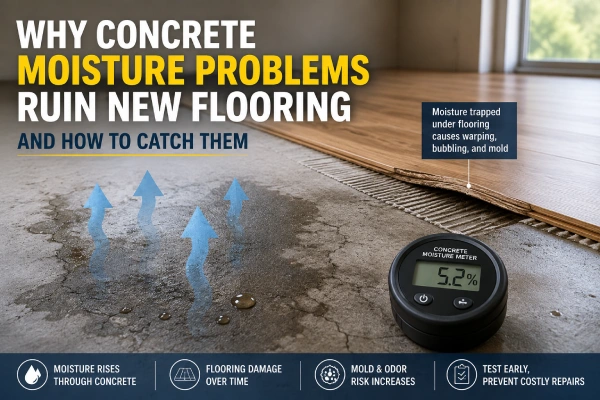
Have you ever walked into a newly renovated room and noticed the floor already bubbling, curling at the edges, or giving off a faint musty smell within months of installation? It is a frustrating, expensive discovery, and it almost always traces back to something invisible that happened before the flooring ever went down: moisture trapped inside the concrete slab underneath.

Concrete looks solid and dry to the eye long before it actually is. That gap between appearance and reality is exactly where flooring failures begin, and understanding it is the first step toward avoiding a very costly mistake.
Why Concrete Holds Onto Moisture Longer Than You Think
Concrete is not an inert, finished material the moment it hardens. It continues releasing water vapor from deep within the slab for weeks, months, or even longer, depending on thickness, mix design, and surrounding humidity. That moisture migrates slowly from the bottom of the slab toward the surface, which means a slab can feel completely dry to the touch while still carrying significant humidity internally.
This is exactly the gap that causes so many flooring failures. A contractor or homeowner checks the surface, sees no visible dampness, and assumes the slab is ready, when the real moisture level several inches down tells a very different story.
How Does Moisture Actually Ruin New Flooring?
Excess moisture trapped in a concrete slab causes flooring failure through a few specific, well-documented mechanisms rather than a single vague problem.
- Adhesive breakdown. Moisture vapor pushing up through the slab weakens the bond between adhesive and flooring, eventually causing the flooring to lift, bubble, or separate entirely.
- Warping and peaking. Hardwood and engineered wood flooring absorb excess moisture unevenly, causing boards to cup, crown, or peak at the seams as they expand and contract.
- Discoloration and staining. Moisture reacting with adhesive or subfloor materials can create visible dark patches that show through certain flooring types, particularly vinyl and laminate.
- Mold and microbial growth. Trapped moisture beneath a sealed flooring surface creates exactly the warm, dark, humid conditions mold needs to establish itself, often invisibly until the smell or health symptoms appear.
- Voided manufacturer warranties. Most flooring manufacturers require documented moisture testing before installation, and skipping that step can void coverage entirely if a failure occurs later.
According to ASTM International’s F2170 standard, the official test method for determining relative humidity in concrete floor slabs, excessive moisture in floor slabs after floor covering has been installed can cause floor covering system failures including debonding, peaking, and deterioration of finish flooring, along with microbial growth. That guidance comes directly from the industry body responsible for setting the testing standard flooring manufacturers rely on.
Choosing the Right Tool for the Job
Reliable moisture testing for concrete depends on using equipment actually calibrated for concrete’s density, rather than a general-purpose meter built for lighter materials like wood or drywall. Concrete’s mineral density behaves very differently under both resistance and electromagnetic sensing methods, which means a meter tuned for the wrong substrate can return a confident-looking number that has little bearing on the slab’s actual condition.
Rather than assuming one meter can accurately measure every building material, SensoraHome designs its concrete moisture meter lineup with substrate-specific calibrations to improve measurement accuracy.
Why Visual Inspection Alone Cannot Catch This
Concrete can appear completely dry on the surface while still retaining significant moisture deeper within the slab. Because that hidden moisture is invisible, relying on appearance or touch alone provides no reliable indication of whether the concrete is actually ready for flooring installation.
This is exactly why proper moisture testing is such an important part of the installation process. Identifying elevated moisture levels before flooring is installed helps prevent avoidable failures later, whereas depending on a quick visual inspection remains one of the most common reasons moisture-related flooring problems occur.
What Proper Moisture Testing for Concrete Actually Involves
Testing concrete moisture correctly means measuring conditions inside the slab, not just at the surface, since surface readings can be misleading in either direction depending on recent weather or cleaning.
Relative Humidity Testing
The industry standard approach involves probes inserted into the slab at a specific depth, typically 40 percent of the slab thickness when drying from one side, left to equilibrate before taking a reading. Most flooring manufacturers require a relative humidity reading at or below 75 percent before installation proceeds.
Surface and Handheld Scanning
Handheld moisture meters offer a faster, non-destructive way to check for elevated moisture across a larger area before committing to more precise in-slab testing, useful for identifying problem zones on a slab before drilling anywhere.
Timing the Test Correctly
Testing too early, before a new slab has had adequate time to cure, or skipping a retest after a water intrusion event, both lead to unreliable results. Moisture conditions inside concrete change slowly, so testing needs to happen at the right point in the timeline, not just once as a formality.
Final Thoughts
Concrete moisture problems are one of the most preventable, yet most commonly overlooked, causes of flooring failure, largely because the moisture responsible is invisible until the damage has already started.
Understanding why concrete holds onto internal moisture far longer than it appears to, and testing properly before any flooring goes down, protects both the investment in the flooring itself and the labor that goes into installing it. A slab that looks dry is not the same as a slab that has actually met the moisture threshold flooring manufacturers require, and closing that gap with proper testing is a small step that prevents a genuinely expensive mistake.